Data Processor: The Full Story
I didn’t think I wanted to work in Banking. Sure, I liked numbers, but banking was its own beast.
I started in the back office of the Shared Services Department (SSD) as a Statements Clerk. It was just as it sounds. I printed bank statements for customers, folded them, and sent them in the mail. Six months into my job, just as my probation period was about to end, my manager, the manager of the department, asked me if I wanted to cross-train as a Data Processor. At the time, all I knew was there was a chance to make more money. So, I said sure, thinking “How bad could it be?” The next few years of my life would prove to be some of the most challenging. Not just because of the job, but everything else going on in the world at large.
The Early Days
I remember the department was separated. Statements was in its own room, away from the rest of the department. I would come to work and be unaware of the work being performed outside of those walls. I felt like I was new all over again when I first sat at what would become my new desk on the other side of the department. I felt like a stranger in my own department.
I’m not the most talkative at first. I like to get a sense of the room before I do. So, I came, did my tasks, and went home. Early on, I remember the team being shocked when I finally started joining in on the discussions like, “Where did that just come from? Oh, that was Alejandro! I didn’t even know you could talk!” Or my favorite reaction: “Honestly, I forgot you were even there!”
As Data Processors, our job was to primarily post transactions and process rejects & exceptions. There were at least five ways to post transactions. Each of these had its own distinct process, and learning them all, rotating between each of them week after week, day to day, was a new challenge.
As a team of three, we split the work by one person handling the salary distribution rejects, another handling the manual work that came from the sessions, and the third would cover journals, other salary entries, and any other one-off tasks for the desk. We worked shifts of 9-5, 10-6, & 11-7 and would rotate weekly.
I was exposed to a new side of the bank’s core system. Sure, I had access to it as a Statements Clerk, but the way we used it as Data Processors was completely different. As a Data Processor, you have a vantage point that few in the bank have. You could see customer accounts, historical transactions, loans and their history, and salary setups. This helped with the level of research we would have to perform and provided a certain understanding of how the bank operated that few could see or understand.
On my first day of cross-training, in May 2019, I started doing salary rejects. There were many reasons a salary could be rejected. It was the job of the Data Processor to research the entry, get the details for it from the session file, and then research it in the system to find the correct customer and where it should be posted.
I remember when I first started, there would be 60-70 rejects per session. There were 7 sessions per day: 8:15, 9:00, 9:30, 11:30, 1:30, 3:30, & 4:45. There were also salary rejections from salaries being posted by the Salary Clerk. We averaged around 200 – 300 rejects a day. Sometimes I’d be in the middle of completing the rejects from the previous session when a new batch would show up on my desk.
It was easy to feel overwhelmed on the desk. Overtime became a new regular for me. I still remember the first time it happened. I was working 10-6, and I saw the other Data Processors weren’t moving. The day had ended, but there was still work to complete. That was my first lesson on how this team approached work: the day ended when the work was complete, not because the clock struck a magic number. I stayed, with the quiet understanding that we all leave when the work is done. I worked two hours of overtime on my first day of cross-training. I still have the email they sent the next day thanking us for the sacrifice. It was a small one at first. What was one afternoon?
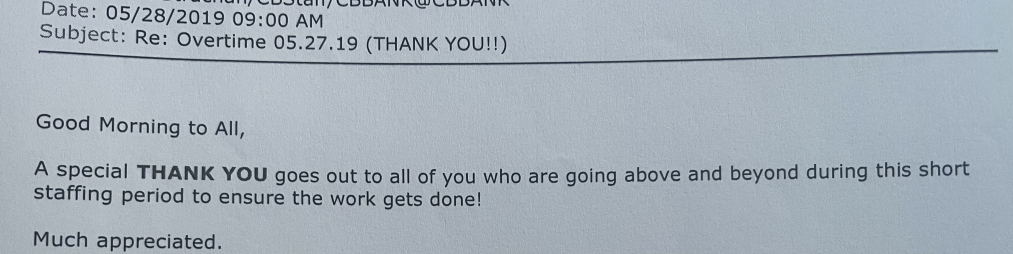
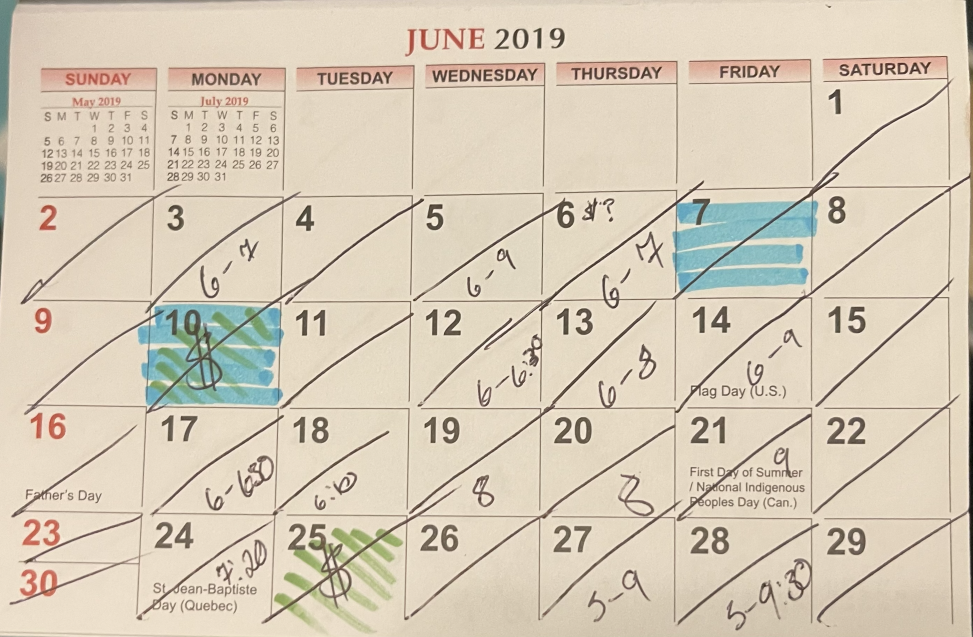
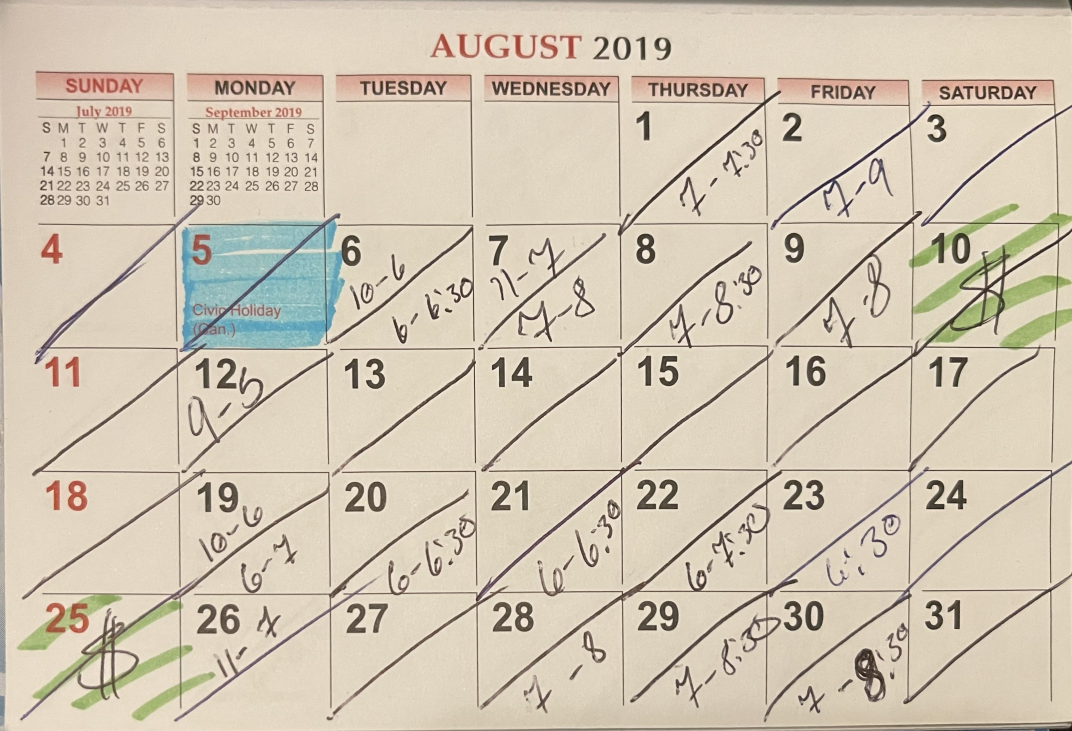
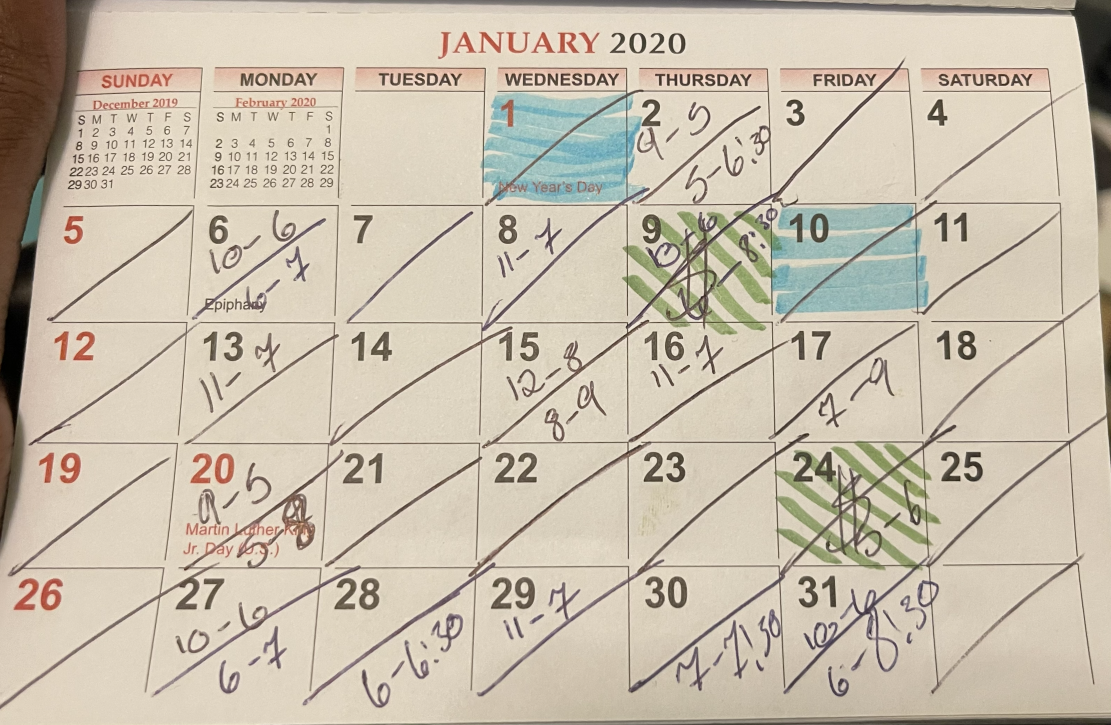
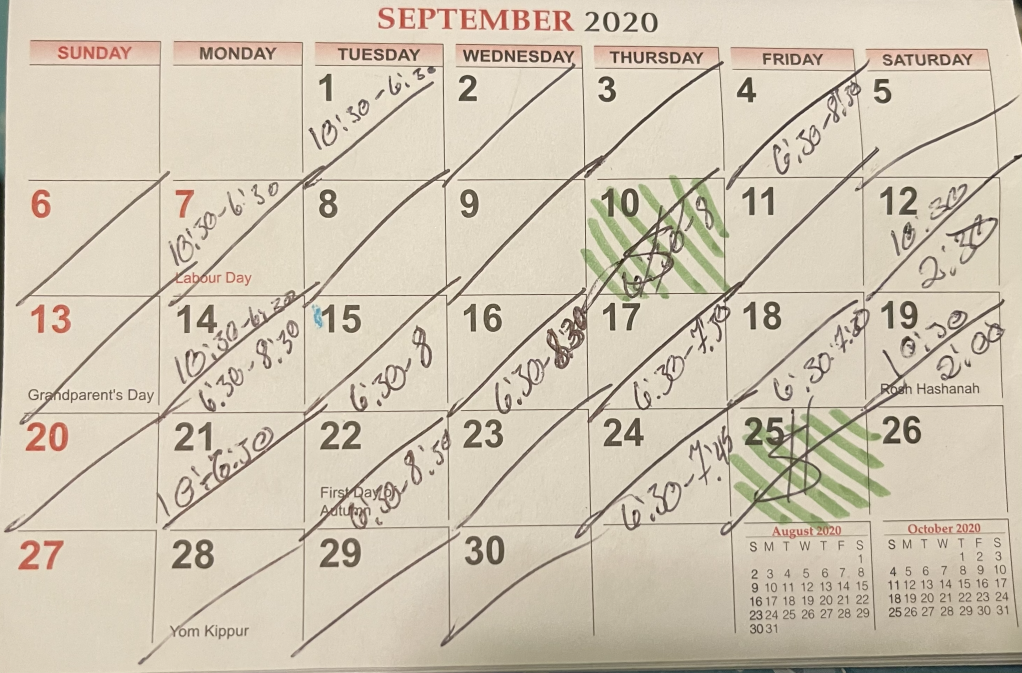
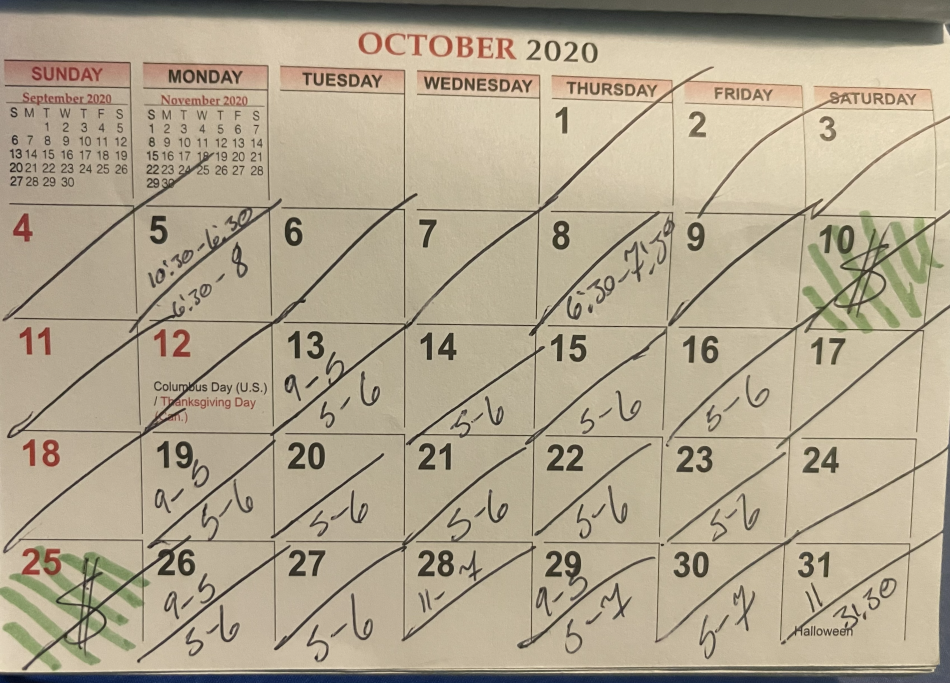
I started logging all my overtime in my desk calendar, so as not to forget it by the next week. I also highlighted our pay days as a motivation. I could look at the calendar and know what I was working towards.
A Practical Joke
An early experience was when a coworker swapped phones with me. I didn’t know why. He was previously a Data Processor and someone the branches had come to call on. He gave me his extension as a practical joke, and it stuck. I remember the first time someone called the line asking for him. I said, “No, this is Alejandro”. Confused because they didn’t know who I was, they just went right into their query. They were looking for a salary. I had only been cross-training for a few short weeks at the time. I had no idea how to help them. I put my hand over the phone and asked on the floor if someone could help me find what they were looking for. Thankfully, someone heard me and came over and helped. They did the research themselves on my computer. I tried to pay attention as much as possible so the next time I wouldn’t need to bother anyone.
That started to become my go-to move. I would try my best to help as I started learning how to do research, but if I got lost at any point, I would call on someone to help. The Data team consisted of two supervisors, the SSD Clerk, the Salary Clerk, the Reconciliations Clerk, and three Data Processors. We all worked on the same system, but different aspects, so I might know something someone else doesn’t. This new habit quickly helped me to learn how to navigate the bank’s system. Over time, I came to understand something about our team: We had a set of skills no one else could perform.
One thing about this job, this position, was that it was very technical. Even now I find it hard to discuss what we did in a way that can be translated to other professionals. If you have never worked in SSD or in digital payments, you just don’t get it.
The Grind
As overtime persisted, I learned quickly that if I wanted to leave on time or at a reasonable time, I was going to have to be fast and accurate. The number keypad on the right of the keyboard became my best friend. My fingers became nimble, moving faster than I could think about it. Once I saw the number, my fingers jumped into action. I still know that part of the keyboard with a blindfold on. I tried getting that good with the letters but never quite like how I could move with the numbers.
As I got better with the rejects, I would get through them quicker. I tried to manage my time as best as possible, originally thinking the overtime was a result of poor work management of the Data team. That was also quickly debunked.
The Cost
Early on, within the first month of cross-training, I realized that my social life was going to be affected. I worked overtime just about every day my first month, even up to 4 ½ hours of overtime in one day. I had put in a 12-hour day, and it wouldn’t be my last. I was thrown into a workforce that was poorly managed, and I couldn’t focus on that just yet because I was just learning how to swim through all of it. I eventually learned not to make any plans earlier than 10 o’clock. I would set appointments for haircuts or schedule a movie time with friends and have to cancel because I couldn’t leave my desk. Going out for lunch would mean more overtime, and I couldn’t guarantee when I was going to get off. I couldn’t even get a haircut throughout the week because my barber went by appointment only.
Then there was the fatigue after all those hours worked. My mind felt like pudding. I couldn’t take on any new information. Trying to keep track of everything that happened on any given day at work took all my focus.
I didn’t know it then, but those hours were adding up. By the end, I would work over 500 hours of overtime. That’s an additional sixty-two 8-hour days, not including lunch, over the span of three and a half years. That doesn’t feel like it does justice to what that time meant or felt like. I had posted over 159,000 manual entries and made only 213 errors (0.15%), & possibly over 7,000 journals (had to create a measure myself).
Signing the Contract
I was confident that once this cross-training was complete, the official Data Processor contract would be nice. I was severely disappointed. Not only had I practically been a Data Processor for the past six months, but I was also a strong member of the team by now. I could perform the desk adequately, better than some. There was no stipend, no increase to salary during this time. The cross-training wasn’t cross-training. I didn’t come to work and perform Statement Clerk work and then, for a portion of the day, train as a Data Processor. I only performed Data Processor tasks. I was working as a Data Processor and being paid as a Statements Clerk. It didn’t seem fair.
My salary was appropriate for a Statements Clerk. The role didn’t require much skill. However, I had become so much more than that. I felt like I had proven myself to not be mediocre, but someone who performed well and deserved to be compensated for good work. The contract showcased the full range of the Data Processor role. The contract presented to me placed me at the bare minimum of the range.
I struggled with this for a long time. I knew other Data Processors; I knew the kind of work we all did. I looked at the work that I had produced and did not feel like I was producing bare-minimum work. I was looking for something close to the middle. It would’ve said, “We see the work you’ve done and value the contribution you make to this department.” I felt I was being undervalued.
Yes, it was a 22% increase, and that kind of percentage increase for any position is significant. Yet, I felt this contract didn’t understand the actual work that went into what we did as a department, and the pay didn’t reflect the risks involved. I almost didn’t sign the contract because I couldn’t believe that after all the work they had already seen me produce, all the overtime I had put in, they gave me that contract and said: “This is how much we value you”.
I felt I had little to argue with. I had no degree, no skills that could make the work easier, not yet. I was new to the role and lacked credibility to explain why I deserved more. I feared speaking up about it. The fear of what management would say at such a request. I understood, even then, that there were policies and bands and limits I couldn’t see. But understanding the logic didn’t make it feel any less like being told I was worth the minimum.
The alternative to not signing was to go back to folding statements, and they had already said that the statements team was dissolving in a few months as the bank would no longer be printing statements. I had a difficult choice, and I was young with no experience dealing with management and understanding my value. When you don’t know that you can speak up and change things, you stay and end up in situations you don’t deserve to be in.
To anyone reading this: If you are early in your career, please know you have value. A job does not determine your value. Just as they are getting something from you, you are looking for something from them. Know what you want when you go to the interview and let what you want be more than just a job, because I can assure you some jobs will break you if you don’t know what you signed up for. Ask questions in the interview; know if the workplace is a fit for you. You might even end up like me and realize that it may not be a great fit, but the experience gained makes it worth it. That’s fine as long as you have a plan and know what you are doing. Don’t get comfortable somewhere that you don’t belong.
So, in January 2020, I signed the contract. What else was I going to do? I felt they had to pay me for all the stress I had already endured, even if I felt like I deserved more. I didn’t have plans to stay long. I knew I was going to need a change. That life wasn’t sustainable, and I needed to prioritize myself.
Communication
I remember when a relatively new team member who came from the branch had a conversation with us. They said that they thought we liked the overtime. That was so infuriating to hear because of how inaccurate it was. If I could guarantee that I would only work the hours I am required by my contract, get the work done, and go home on time, never knowing when I’m leaving and getting an extra $50 – 100, I would take going home on time every single time, no questions asked.
Something that was not clear to me at that time was communication and how important it was. At the time, I felt it was my management’s responsibility to see the issue and then come to us and have a conversation to address it. I didn’t see that it was also my responsibility as an employee to raise my concerns to management for them to know what we were experiencing. When we would meet, management’s solutions were always shift-based. They felt we were just coming in to work too early and needed to stay later. They tried to make all of us come in from 12-8. We didn’t like that because the days we didn’t need to be there that late wouldn’t help, and what about the work that comes earlier? Now we would just come to work with a stack of work waiting for us. We often would enter these meetings frustrated from the workload and wouldn’t take the opportunity to speak up about the frustrations we were experiencing.
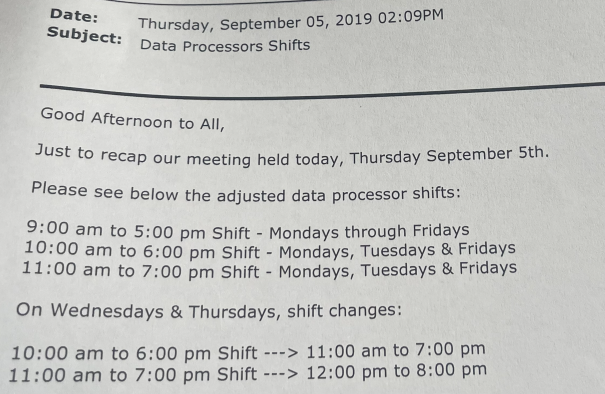
These meetings were also few and far between and usually came with management already presenting a solution rather than coming with open ears to hear our concerns. I feel like that contributed to a disconnect. There were experiences that, without sitting on the floor, you wouldn’t understand. If I said I got 100 journals to post, that just sounds like a number, irrelevant to anything else. What that means to a Data Processor is I’m about to sit at my desk for the next hour and a half posting, with a chance that some of these journals won’t post due to preparation issues. The problem was more complex than shifts, and the solution required more understanding than a bird’s-eye view.
The Enemy
The whole team had gone through a major system upgrade months prior to my joining the team, which resulted in long days, significant overtime, and weekends worked. They were scarred and angry. Many had a disposition of neglect from management. They felt management only saw their own agendas and didn’t care for the employees or what they had to say. You could see it in their attitude and their approach to work.
That disposition eventually became my own. After all that I had experienced with management, I was disgruntled as well. We would have conversations on the floor and discuss our frustrations regularly. We worked after normal hours, so management would have already left for the day. We could speak as we pleased.
What that brought about was a strong feeling of togetherness for the team that was there and strong disdain for management and anyone who didn’t work the way we did. Many were disgruntled with branch members calling. They wouldn’t answer the phones because they felt the branches called too much, that it wasn’t their job to answer their queries. They resented the other team members who had an 8:30-4:30 shift consistently. We would hear them leaving for the day, sometimes laughing amongst themselves. We would all be on the other side going “must be nice!” Everyone who didn’t work with us was essentially the enemy.
A Different Mindset
It was difficult to remain positive with that kind of mentality being so strong amongst the team. I answered phone calls regularly because, despite the branch not knowing what we were going through, they have customers in front of them with these queries, and ultimately the customer is who we’re working for. I had to fight hard within myself to have a different outlook than everyone else, even so bold as to speak up at times on the floor and to spread a different narrative.
At the time, that was a great fear of mine. I grew up different than most and was often afraid to have the views that I did and would keep them to myself. This felt like an opportunity to stand up, be bold, and unafraid of the reaction. I quickly learned a different lesson. While it was good for my own personal growth to be bold in my stance and different despite the crowd, the crowd wins because of group thought. We as humans can’t fight it, no matter how hard we try. A noble effort, but effort better utilized elsewhere.
So, I would keep my thoughts to myself now, not out of fear but because that wasn’t the time to share them. I would find more strategic ways of introducing new thoughts to the team. Sometimes speaking with one team member at a time, getting them to see my view and share theirs as well. This worked better than expected, and eventually I felt like the team had warmed up a bit. In some instances, they weren’t as cynical.
I felt many of my views and principles as a person were challenged through these team discussions, even keeping positive within myself despite all the negativity. The work and environment really broke me down and showed me my core, who I really was when tested. Despite the challenges, I was still positive. I still had my principles that I stood by and lived by, and I found ways to continue to be myself despite the dynamics of the floor. I eventually stopped joining in on the discussions as much. I wouldn’t get caught up in the talk. It only riled up my own anger and frustrations and offered no solutions. I would instead think of ways to address these matters.
I found myself talking to management more. I wouldn’t just be frustrated; I would express my concerns. I would tell them some of the matters we experienced, and if I heard a good suggestion on the floor or had one myself, I would share it with management and see their reaction. Not everything was heard and implemented, but I also wasn’t sitting around just being frustrated with no outlet.
Some solutions didn’t need management’s involvement. Sometimes I would just do things differently myself to avoid the frustration. Other times, I would speak with different team members and get a better understanding of what had happened to see how we could avoid it in the future or better communicate about it.
Becoming A Team
We mainly worked in silos despite being a team of Data Processors. If I was on rejects, I only did rejects. If that meant someone else worked overtime when I was done and could have helped, that wasn’t my problem. We were not kind to each other, dealing with our own frustrations and feeling everyone on the team didn’t pull their weight.
We handled things with pettiness, not maturity and the pettiness only brought discord amongst the team. There were only three of us. If we didn’t find a way to work together, we would only have another layer of frustrations to deal with. It didn’t make the work any easier, and the work was the problem, not the team members.
One Person
I had to find a new way to address the frustrations and it wasn’t easy making that shift. I started making sacrifices others on the team weren’t making. It felt like the other two team members were of the mindset: “Well, I can’t guarantee that the other person would do it for me if I did it for them, so I won’t do it for them”.
I would sometimes work overtime just to make sure they didn’t. If I was on the 9-5 shift, I would stay back an hour to help with any work if it looked too heavy to make sure the 10-6 could get off at 6 and 11-7 could get off at 7. Those small sacrifices made us a team. We started talking to each other more, tackling the work as a team and not in silos. The person on rejects wouldn’t only do rejects. If they finished prepping rejects and there was other work to do, they would pitch in until the next set of rejects came. Same for the person on manual and journals.
I developed a mentality of not focusing on my teams’ shortcomings. Sure, they were still petty at times amongst each other, but it only took one person to make a change. Eventually, after seeing my demeanor and not complaining about it and how they both benefited, they would do it for me and eventually would do it for each other. We stopped fighting each other and focused on fighting the work and everyone else.
The Phone Calls
Through many calls and conversations, I developed relationships with various branch team members. I became the person to call if you needed something from SSD. This called for a poise that wasn’t always easy. I told myself that I would always answer the phone, no matter what. That meant even on my busiest days, in my busiest moments, I would pick up the phone and not carry the energy through the phone. Not always easy, and I didn’t always have the time, but I did my best to research what I could for them, knowing only my team had access to the information. I sometimes asked them to just send an email, and I would research the matter when I got the chance. I would complete the research within the week. I tried to respond quickly and get them out of the way, not letting them pile up.
I developed good relationships with the departments that sent journals for posting. So much so that I would call them about journal issues rather than sending an email or notifying management. Some issues could be resolved with a call and a conversation. These relationships would serve me later in my career.
A Young Man, not just a Young Professional
When I joined the team back in November 2018, I aspired to go to Synergy and take their A+ certification course. I wanted to have something to ground me as I wanted to work in IT. I even wanted to possibly go back to college and actually get a degree. Those felt like pipe dreams with my schedule. Never knowing when I would get off from work meant I couldn’t seriously consider classes after work that required in-person attendance.
I also had dreams of being able to afford my own travel, taking solo trips in my early 20s. The aspirations of a young man who was also navigating being a young professional. The pandemic really affected me, not just because of the work but even my personal goals. Trapped at home, nothing to do except go to work.
The Challenge
I had a unique challenge for myself. Rather than seeing every issue as a new frustration, to try to see things differently. When a session would get delayed, and a stack of rejects was coming my way or a stack of manual entries to post, I would challenge myself to see how fast I could get through it all. It would be a personal accomplishment. Those small challenges made the work easier. Especially on days that weren’t heavy, I had become so efficient through these personal challenges that they were a breeze.
I felt like leaving so often; I almost did as well. As I was gearing up to make the decision, the pandemic hit. With the uncertainty of job security at the time, I decided to stay and tough it out. There was the fear of possibly not working and a fear of marketability. So much of what I had done I had no idea how to explain to someone else who hadn’t worked in it, let alone be able to write it on a resume in a way that made sense. I eventually stopped looking for a way out and found myself finding ways to make the most of a difficult situation.
The Pandemic Pause
The pandemic changed a lot for the team. We were constantly asking management to hire a fourth Data Processor to alleviate the overtime and heavy workload, and the pandemic saw them try to reduce us to two for a time. We would rotate every 3 days. I worked two days and got the next day off. The same for the other Data Processors. One day I worked with one, the next the other, and the third day they worked without me. We were confused and more disorganized than ever before. When we came back the following day, because we weren’t there the day before, we didn’t know what we were walking into. One of the beauties of the Data team was how we worked together. With some team members not at work, you could feel it in the way the work got done.
We also saw a major increase in work. Since customers couldn’t come into the branch for certain transactions, there was an influx of online transfers, increasing the manual posting workload. Being down a Data Processor saw some of the work actually get left for the next day because we had restrictions on how long we could be in the office. With Nationwide lockdowns, we couldn’t work the overtime to complete it all. It was also too much work for just two people. Increased workload with fewer staff after requesting additional help before the increase.
I even came in on weekends to post the work we couldn’t complete throughout the week to make sure it didn’t spill into the next week. Even crazier was the official work hours. The banks had all agreed to reduce the hours worked. Yet, as Data Processors, we didn’t earn overtime until after working 8 hours. So not only were we working up until the last possible moment with curfews, but we also worked extra time more than anyone else and weren’t compensated for it.
SSD Clerk
In August 2020, in the heart of the pandemic, management asked me to cross-train in a new position, the SSD Clerk. I had little understanding of what the desk entailed despite working alongside this person for the past year and some. What made it interesting was how particular this individual was about their work. They had their own frustrations outside of what we were going through as Data Processors. I learned quickly about a new perspective on the department and what was really going on.
The SSD Clerk was like me and cared deeply about the quality of their work. They had been the only person in charge of this level of work for years, so they didn’t take too kindly to me coming in and disrupting their process. I learned that this desk handled most of the tasks that couldn’t be easily defined under the other desks. That meant we handled a unique blend of tasks that all had their own processes. I gained a lot of technical expertise through this cross-training.
I reviewed cheques entered by the Clearing clerks for accuracy and logged errors to be corrected. A manual process that was tedious and abhorred by me. I handled dividends, sessions, and government deductions. There was also a salary that had a special process for how it was handled that this desk was responsible for. These were all tasks that were new to me that I didn’t know were happening in the department that I had been working in. Each process taught me more about the department and the work we did and different ways of achieving goals.
Dividends were simple enough. We would receive the files from the external team in charge of dividends, and we would process the files. We would first verify receipt of the funds. Next, we would go into a special room called the ACH room to process the dividends. This room was also where salaries and sessions were processed. We would use a program to separate the file into entries for our bank and entries for other banks. We would verify the amounts and count of total entries to ensure all were accounted for and then prepare the files for posting. This was crucial as these files, on average, contained 3,800+ entries and were millions of dollars moving through our bank. There was basically no room for error. External entries to be sent to other banks required the SSD Clerk to first upload the file and then for a supervisor to come after and approve the file based on the verification done by the SSD Clerk. Next, the internal portion would either be uploaded or given to the Data Processors for manual posting. Afterwards, we would prepare a journal outlining all of these details to be posted to the appropriate GLs and customer accounts.
The government deductions, commonly known as RGs, came once a month. It made it hard to learn and fully grasp the process quickly since you only got one chance at it. So that took about 4 months to go smoothly. The deductions would come in separate sections, and each section had its own process for preparation. Remembering each of those details was the hard part at first.
Both Sides
The sessions were a highlight. I thoroughly enjoyed learning what the other side of the process looked like. It gave me a new perspective that changed my view of our work forever. I was happy to take on sessions and get more practice with them. We would download the files received from the other banks and then process them. We would examine all the entries and determine which were salaries and which were entries to be extracted and posted manually. We would need to ensure that all manual entries were printed and verify the amount being uploaded through the salary distribution system. You would have to balance the session after this, so it was pivotal to have the correct amounts recorded. After the upload of the salaries and deductions, we would print the rejects to be prepped by the Data Processors.
The SSD Clerk oversaw the posting of the rejects after the Data Processors prepped them; rejects from the session the SSD Clerk processed would go to the Salary Clerk or Supervisors. There would also be other items in what was called the Exception Item Management (EIM) system. It was the SSD Clerk’s responsibility to monitor this system for any other rejects or exceptions from items being posted across the bank and prepare and post them to the correct locations.
I went from the person who received the manual work and the rejects from the session to the person who prepared the session. I would now be the person who posted the rejects after the Data Processors were done prepping them. It gave me an understanding that in a few months I was able to address matters that had plagued me since joining the Data team.
I enjoyed the session process so much that I would sometimes ask others who had a session if I could handle it for them. I learned about the salary distribution system that held all the companies we received salaries for. I saw how a simple amendment in this system could fix many rejects and provide relief to the team. I spoke with my supervisors, and once they agreed, I started implementing changes that saw rejects reduce and become manageable.
The Supervisors, SSD Clerk, Salary Clerk, & Reconciliations Clerk all handled sessions. Some people handled sessions better than others, and you would see it in the rejects or how long it took them to complete the session. Sometimes you would see rejects from entries that, as Data Processors, we knew weren’t supposed to be uploaded. Other times you would see entries that were taken out to be posted manually that were meant to be uploaded. This lack of uniformity across all sessions and people who managed sessions made our workload heavier as Data Processors. We didn’t understand what it took to prepare a session, so we rarely said anything, but we felt the frustrations. Now seeing the other side, I tried to get everyone on the same page because if we managed the work coming out of the ACH room well, the whole team benefited.
The Lost Customer
Another task I completed was the processing of a salary that we handled differently from all other salaries. It was the SSD Clerk’s responsibility to manage the listing of customers who worked for this company, updating it every week as the salary came in and after the Data Processors posted the rejects and exceptions from this salary. I had been on the receiving end of the process, the rejects and exceptions, as a Data Processor, but now I see how they came about. I saw how a process I did as a Data Processor actually affected someone else’s work and eventually my own.
I learned how to read different reports in the system, seeing how these salaries were posted. I started understanding this process well enough to reduce rejects and exceptions through better management of the listing. Through a collaboration of research received from the branches and my understanding of how the listing and system work, I corrected various problem customers.
One day, answering the phone paid off. I had this payment that I would see as a Data Processor from this same company, and I could not identify the customer. We would reject the payment and post it to a suspense GL until we could find the customer. We had specific instructions from this company not to return any payments. So, the payment was rejected every week for at least two years. I adopted the process of rejecting the customer deduction since it was happening before I even joined the team. I had tried researching it at different points and couldn’t find anything. It was as if this person did not exist.
Then one day someone called looking for this customer’s payment from this company. After they gave me the details, I found out that it was this customer. They had a different last name in the system, and the name was cut off in the file we received. I was so relieved to be able to help them set that customer up and post all those backdated payments to them and out of the GL.
Recognized but Unofficial – The Hybrid Worker
During this time, I had created a process to handle the influx of ACH transfers from other banks with the help of another coworker. We received recognition from our management team and the bank for making a change to a process through a bank initiative called In Your Line of Sight. It significantly helped with the increased workload. The new process was heavily Excel-based, and I used some of my new skills gained from the SSD Clerk desk to help create the process.
I couldn’t fully leave being a Data Processor during this cross-training. I would have to transition throughout the day. I might complete a dividend file and then have to go into posting manual entries or preparing rejects from sessions I didn’t prepare. I was happy when I did a session because it meant I couldn’t post any of the work from that session, as a segregation of duties. I even trained a Clearing Clerk on the Data Processor desk as I was the most skilled Data Processor at the time. I balanced all these duties on any given day.
This cross-training also didn’t come with any stipend or increase in salary, yet I filled in for this desk when the official clerk was out of office. I learned the desk so well that I eventually brought some process improvements to various aspects of the desk. Wrote new process flows showcasing the revisions for others to use. Even after I had learned the full desk, I continued to cross-train, completing tasks as needed. I would take on a blend of work from both desks, Data Processor & SSD clerk. During this time, I made many improvements to the session process and tried to get everyone on board with my fellow Data Processors in mind. I tried to keep rejects between 20 & 30 per session, which meant more consistent days for the Data Processors.
This cross-training was also longer than others. Most cross-training is expected to take six months. However, I technically cross-trained for fourteen months. To make it worse, this cross-training was not official. I didn’t sign a letter, and I later learned that HR was unaware of my work. From a bank perspective, I was just a Data Processor, and I was so much more by the end of this era. I cross-trained unofficially from August 2020 until they wanted me to cross-train as the Salary Clerk because you couldn’t cross-train on more than one desk at a time.
Salary Clerk
In September 2021, management approached me to cross-train on the Salary Clerk desk. I had no real interest in it; I was happy with where I was. I asked if I could have some time to decide, and they said: “Sure, but if you don’t accept, we’ll just find someone else who is willing.” Why did they say that? Because now I have to take it! No one else was going to learn something new while I could take on the challenge. Prideful, I know. Plus, I didn’t want anyone messing up the process, creating more work for everyone else.
The Salary Clerk desk was hectic. The processes were no different from the work I had covered on the SSD Clerk desk, just different volumes. While you could receive up to 20 dividends a month as the SSD Clerk, you received a minimum of 20 salaries to process a day.
I would maintain a log of all salaries received each day and when they were processed. I would specify if there was an external file to send and how it was received. Most were digital files. Others were still received through cheques. For the digital files, we would check that the customer’s accounts had sufficient funds for the file to be posted and would prepare a journal at the end of the day with all the salaries processed.
I found this desk so challenging because you were constantly looking at your email and then in the ACH room processing the files. To make it harder, at the time, the 11:30 session was assigned to the Salary Clerk and was usually the largest session of the day. You had to cover all these salaries and still do your session promptly because your speed affected other people’s work and customers receiving their money. The constant back and forth was taxing. Some days we processed up to 50 salary files. You had little to no time to breathe.
It was at this time that I found myself accomplishing a random goal. One day we found ourselves short-staffed to the point where only three people who could process sessions were in the office, one of them being me. I decided to attempt to process all the sessions that day, just to see if I could. I came one shy. Someone processed the 1:30 session, but I processed everything else! It was like a bragging rights token. We had seen some wild days in SSD, difficult to handle. To be able to do something like that would’ve been impressive. A little upset I never got to claim that title.
I asked the Salary Clerk at the time how they handled it because I had worked in this department with them for years now and had no idea this desk was as bad as it was. Now that we had each other, we started to tackle the desk together. I would help, however I could, cover the session so they could keep working on salaries or downloading the files from the email and adding them to the log for them to process in the ACH room.
I eventually started to balance all three desks, while still being a Data Processor, helping with the SSD Clerk when I could and cross-training and assisting the Salary Clerk. I was moving around doing whatever was needed. I was a hybrid worker with no real position. I could be doing several different tasks on any given day. On days I didn’t want to post, I would find my way into the ACH room to process a session and give the work to others. A unique position the other Data Processors couldn’t argue with. I would cover sessions for other supervisors or clerks when they were too busy with other work. I became the go-to for any assistance needed across the department. I became a master at my craft, being the person who understood the system from top to bottom. I understood how payments came into the bank; I understood how they were posted and understood the reports and how to research any payment through these reports. I eventually loved research and finding the odd lost payment.
The Log
I eventually looked at the previous year’s salary logs and saw major changes in recent years. Salaries used to be as low as 10 salaries a day, with the heavy days maxing out at 30 occasionally. At the time of my cross-training, your light days were between 20 and 30 files a day, and heavy days were 50. This increase in work had basically gone unnoticed because no one looked at the log. No one reviewed the log and counted the number of salaries. There was enough work now for two salary clerks, and management needed to know.
Almost became a Supervisor
Some weeks after I had started my Salary Clerk cross-training, the Data Supervisor was let go. We went for months without a supervisor, and the position hadn’t been posted. I held the Data Processors down. I felt like the team needed stability, so I stepped up and found myself reaching out to management for answers on day-to-day work matters. There was a gap in his absence, and that gap would have meant things were going to fall apart and chaos would’ve reigned if someone didn’t step in. At the time, I didn’t consider applying for the position, but I enjoyed the new responsibilities I had taken on.
Regularly communicating with management, handled sessions, and communicating with everyone else who had sessions, ensuring things were still running smoothly. If a session was coming up, I would check to see who was responsible for it. If they weren’t there, then I would check to see who was willing to take on an additional session. If no one was able to, then I did it. If a session was delayed, I would ask if they had notified management, and most times, they hadn’t. So, I found myself most of the time speaking to management, keeping them up to date about any matters going on with our team. I really felt good adding stability during this time.
The Interview
When they posted the position, I applied. I was young, sure, but I knew the team better than anyone. Everything I had done so far had to have been proof. I had about two years of experience as a Data Processor at the time, had cross-trained on two other desks at the same time, and could handle the workload of all those desks on a given day if needed. I felt ready.
I prepared for the second time in my life for an interview. I remember watching these videos on leadership interviews and what kind of questions to expect. I prepped my answers and felt I was ready for whatever they could throw at me.
Safe to say I didn’t get the position, and there was no real explanation as to why. I was hurt, not just for not getting the position but also for feeling unseen by the people I had been working alongside for so long. They watched me work, saw what I could do, and felt like they were still asking me to show proof.
I was irritated and, for a while, stopped all the extra assistance I was providing to the team overall. I was just a Data Processor, so let me be just that. I posted my work, answered my calls, and let the extra responsibilities sit with whoever was supposed to carry them.
The End and The Beginning
The Decision
I was still cross-training as a Salary Clerk. So, I started to prepare something for a presentation that the actual Salary Clerk and I would take to them and see what they would do. Before we could present the information, the Salary Clerk took a position in the branch. Then came the real decision. Management wanted to give me the position officially after my time cross-training. I had a hard decision to make, as my decision also affected others on the team. The Clearing Clerk I had trained had a chance to become a Data Processor and finally get paid as one after working as one on and off for months at this point.
Despite all the cross-training I had done for the last year and a half at this point and becoming this hybrid worker across the department, management wanted to give me this position as a lateral move with no increase. I sat at my desk. I knew how much more work was going to come my way, and this time I wouldn’t be able to shift out of it if I wanted to; it would be my full-time priority. I knew if I took it, there would be no lunch breaks, and if the files had increased that much already, they were only going to grow even more.
I was disappointed by the offer. I had hoped for proper compensation when I was offered the Data Processor contract, and now, after all this time, all the work covered, expertise gained, and deep research completed would be the payoff I was waiting for. I was even working up to ask them for a salary increase before this offer. I knew I wasn’t going to get that now either, even if I did ask and present all the evidence that had piled up at this point.
I made a difficult decision and decided to decline. I knew what that meant for the rest of the team. I felt that I wasn’t just deciding about myself and my work; I was deciding for the whole team. I knew what I was worth. I was willing to continue to officially be a Data Processor rather than be disgraced and disregarded as a Salary Clerk. Management had to find someone else to cross-train and eventually give the position to.
The Breaking Point
I was covering work for all these positions, covering gaps for everyone, and eventually it took its toll on me. I had one day where I just couldn’t. I came in to work, and both the SSD Clerk & Salary Clerk were out. It wasn’t the first time it had happened, and before I would cover both desks and still assist with Data Processors when I was done. This day, though, I signed into the emails and saw how much work I had and felt just overwhelmed. I pushed through for a bit, downloaded the files, and started to get to work. I got in the ACH room, and I think there was an error, and that was it. I called my new supervisor over and told them I don’t know what I need, but I can’t do this today. I think I was having a panic attack, but it felt so low — like I felt normal but also on the verge of collapse. She spoke to management and sent me home for the day.
It was needed. Working the way I did, I rarely took time off, no sick days, and the weekends weren’t enough recovery. Especially when I found myself in the office on the weekend covering work that hadn’t been done during the week. I was burnt out badly. I started treating myself differently after that. Every day, I took my lunch hour, no matter what, and if I didn’t, I logged it as overtime like I should have been doing all those years before. I was more rested and felt lighter because of it.
Just a Data Processor
I was just a Data Processor now, and I started to accept this role. My new supervisor was good. She brought stability to the team that I had never seen before. They didn’t need me to be what I was before. I would help wherever I could and just started to enjoy the slower days. I was reaping the benefits of all my hard work. The sessions were smooth, and the rejects were manageable. We Data Processors were getting off on time, and my days didn’t have the weight they used to.
Eventually, I noticed the team was changing. It wasn’t the same team I had met when I joined. We had a new supervisor; two assistant managers left, and at least five clerks. After the Salary Clerk finally left, I started to wonder if there was something for me elsewhere, not wanting to be the last one to leave the ship. I had done my part; the pandemic seemed to be easing up. Not to say leave the bank, but a new department maybe? Then IT posted a position, entry-level. I was nervous. It was one of only two departments I was interested in. Yet, I knew IT had certain prerequisites that were pretty much nonnegotiable. I had never taken the time to take the A+ certification like I had wanted. So, I didn’t apply. Then shortly after, the SSD Clerk announced that they were leaving. My rock in the department was leaving me! After all that cross-training and the relationship we had built, I didn’t know how to continue in the department without her. Amid all of this, I had started testing whether I could still learn.
The year before, in 2021, I took the ABA General Accounting course offered by the bank. I needed a development goal, and it seemed easy enough. I was scared I couldn’t actually study again after being out of school for 6-7 years now. Did I still have that drive? That edge that used to make me stand out? This was a test for myself too to see if I could study and work. I had wanted to take on studies for years now, but the work schedule just didn’t allow it. I was starting to consider online studies, something self-paced. This was my first taste to see if I could handle it. To my surprise, I passed! It was the kind of confidence booster I needed.
This year, 2022, I needed another development goal, so I took the ABA Analyzing Financial Statements course. This was more challenging. I knew little about the work and had to read a chapter of text a week and then complete assignments. With my schedule, my only day available was Sunday. I was reading 30-40 pages of accounting & finance in two hours and then answering questions, replying to scenarios, giving my own comments, and responding to other comments. I almost didn’t make the deadline multiple weeks. I learned a lot and was happy I took the course. I was ready to study again.
A New Challenge
The bank was going through another system upgrade. We had a new process added that saw new GLs be added that were our responsibility. Management needed a process to reconcile these new GLs and all the entries passing through them and had asked me to look at it. I was happy to. I made two processes and, for the fourth time in my time as a Data Processor, created a process flow for the new reconciliation process. I came in on weekends afterwards to train the supervisors on the process. I recently visited, and four years later, they still use this same process.
This same upgrade shifted the way the salary distribution system would process salaries. One of the largest salaries we had was going to be significantly affected, like the whole file rejecting regardless of setups. I reviewed the system and made the adjustments needed, sent the instructions to all the Data Processors in the branches, and gave them a month, the time in between the last salary file and the next one, to update the setups for the customers from this company. The response was amazing. When that salary came in, it had fewer rejects than when it used to come in. The branches had listened and worked with us.
Something that normally would have required going through management, getting their approval, and waiting for them to devise a plan. I avoided all of that and went directly to the source. Management was notified and CC’d on the email, but imagine not taking the initiative. The time it would’ve taken for them to understand the risk, we could have lost the window entirely. To make it even harder, the risk wasn’t even something proven, not on a scale at least. I knew how to do this because I saw a smaller company being affected this way. It had maybe 5 customers’ salaries, and all had rejected despite being set up. I was on rejects, so I researched why this had happened. When I found out, I knew it would affect all salaries. This was just the first. I prepared this same project a few more times for other companies that would’ve been affected by this upgrade. All my experience was paying off in ways that the team couldn’t even see.
The Top of the Mountain
It was at this time that I started to feel like I had reached the top of the mountain. It felt like there was no challenge that I couldn’t handle. System upgrades changed the system, and I created new processes to address massive entries on the reconciliation, reducing reconciling entries down to less than 5. Addressing potential rejects before the rejects even happened. Coordinating with all branches to make updates, taking calls, and assisting. That’s when I knew I needed a change. Some people see that and say, now I am comfortable. I see that and say I have little left to learn here.
The Escape
With the SSD Clerk gone, I was the only backup, and I was next up to take their position. I could see myself taking the position with no increase if they decided to go that route. I liked the SSD Clerk desk. It was slow compared to the other desks I had experienced and smoother. If you were organized, the desk wouldn’t overwhelm you. I was happy to accept when they offered. I held the SSD Clerk position for a few weeks. Within the span of a few weeks, the Finance department posted a position. The other department I would consider leaving for. The position was the same level as my current position, but it was 9-5. I hadn’t worked a normal shift in 3 years. I knew whatever it was, it was going to be easier than anything I’d done in SSD.
Other members of the SSD team were leaving too, opening other positions to apply for. Management didn’t want to see me leave and offered me these other positions. They would have been a grade increase, which meant more money, possibly. They were 9-5s as well, but I knew that if I stayed in SSD, I would continue to be who I was, regardless of my official position. I would be covering all these desks even if that wasn’t my position. The only way to escape was to leave completely. So, I took my interviews with Finance, met with the CFO who set me up with what would become my online self-paced studies, and didn’t look back.
The Other Side
The following months were a transition. My body didn’t know how to work those kinds of hours. I didn’t have enough work to keep me busy all day. I didn’t know what that felt like, to not be busy the entire day. I sometimes would sleep at my desk because the work was done and my body couldn’t stay up with nothing to do. My new management team would be concerned, checking if I was okay. I couldn’t explain that I was bored, that my nervous system was still regulating after years of chaos.
I missed the SSD drama and would find myself spending time off there, sometimes even staying back from 4:30 to 6, not working, just chatting with everyone in SSD. I didn’t know what it meant to be out of the office that early at first. I eventually learned to stay away from SSD, even when I had free time. I was still absorbed in it all. I eventually learned to go and be able to be separate. Eventually, the gossip meant nothing to me; they were experiencing things I hadn’t encountered, and it wasn’t my responsibility to fix it or get involved. After two years and eight months, it was over. I had moved on.
So many days I questioned if I would ever see relief, if I would survive, who I would be on the other side. Most days I felt like there was no other side—that I would either not make it through or this would be my life. The team had little hope. The energy was negative. Being in that environment day in, day out, you get caught up in it. It’s hard to hold onto hope for something better.
This experience challenged my resolve, challenged what I thought I was capable of as a person. I met my breaking point many times and found the nerve to keep going.
When I left, after three and a half years, I had worked over 500 hours of overtime, posted 159,000+ manual entries, possibly ~7,000+ journals, processed almost 300 dividend files (averaging 3,800+ entries each), & processed 1,700+ salary files in four months of cross-training. Through it all, countless tasks weren’t tracked or logged, and sessions that weren’t officially assigned to me that I processed or assisted with. The numbers are one way to measure it. The feeling of a day that never seemed to end is another.
I loved the work that I did during this time. It was challenging and kept me on my toes. I would relish the opportunity to return to this kind of work, same department even, given that certain concerns are addressed and matters handled. I always longed for the opportunity to sit down with management and discuss the challenges we faced and to come up with solutions that benefit the team and bank at large.
What the Desk Taught Me
The Data Processor desk taught me things that can’t be captured in a performance review. As in the Bible, there are examples to follow and examples to avoid. I learned how I would want to approach my team as a leader. From a supervisor and up, I would want to take time out of my week, day, month, and just talk to my team. Hear from them about how they are doing, what the work is like from their perspective. Then not just listen but take what I am hearing and act on it. Think of solutions to their issues that would make their days easier, even if that meant something not in my control, but taking a matter further to my management to get it done. Then not just leave it there and say, “Well, I took it to them, and they didn’t act on it”. I would follow up because it is important to my team and hence it is important to me that matters can be heard and acted on, not just to fall on deaf ears. I would communicate progress, not just leave the team in the dark and provide an update once a matter is complete. I know how frustrating that is on the other end, so I never want to bring that to any team I am on.
Work is always less about the work itself and more about your mental disposition towards it. No matter how hard the task is, if you simply look at it and say this is hard and expect someone else to change it for you, you won’t grow. If you simply complain and don’t act, you won’t grow. You must face the challenge head-on and think with a solutions mindset rather than a defeated one. This is important because if you lose the battle in your mind, you’ve already lost, no matter the task.
You are only one piece to the puzzle. We all must play our part. We complement each other by doing our work well. We work even better when we are proactive and communicate openly and regularly. A well-oiled machine runs smoothly when each part functions as it should. The best teams aren’t just the best individuals placed together. Most times it’s the people who understand who they are working with and understand the goal of the team, not focused on their specific role. They step up when needed, guide when needed, and step back when someone else has a better approach. When a team can function like this, they are unbeatable.
Disclaimer: The views expressed in this article are my own and do not reflect the official policy or position of my employer or any of its affiliates.